
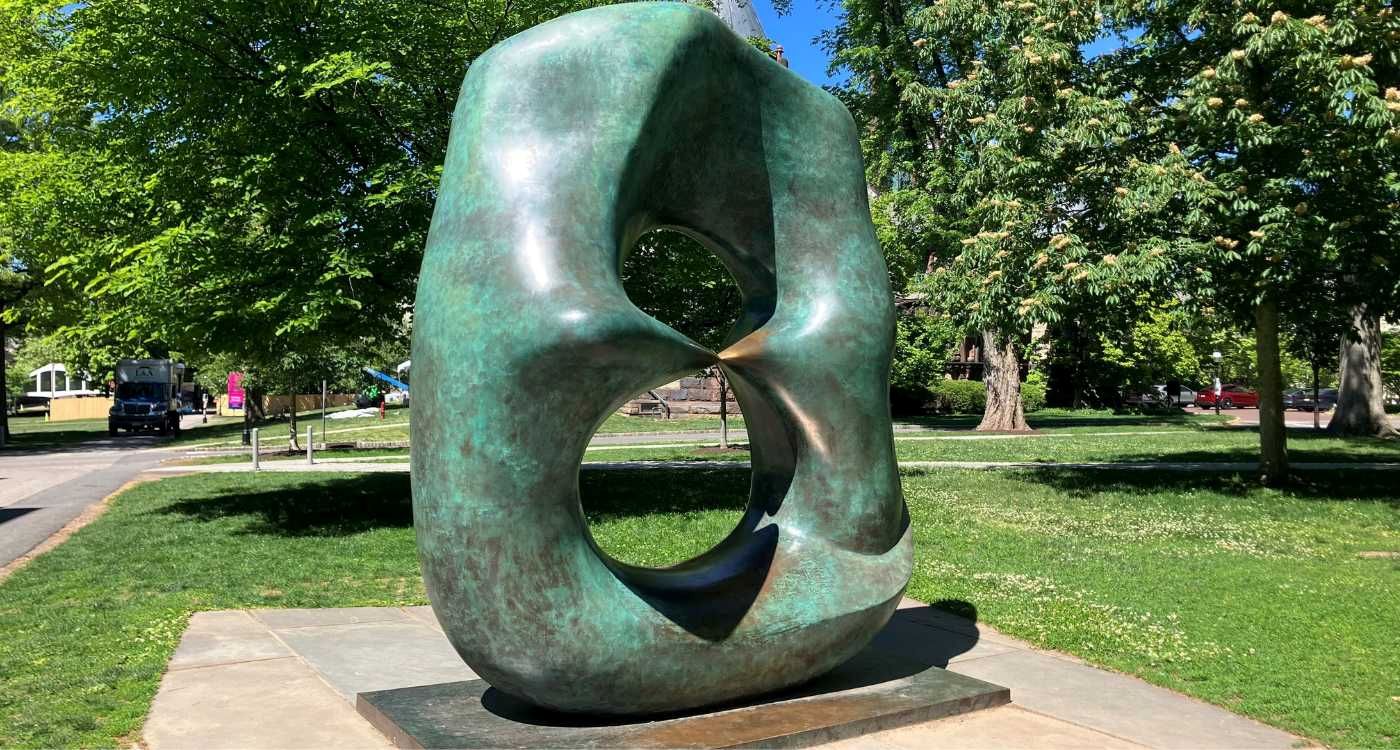
A couple of months ago, I took a glorious spring walk inspired by one of the smallest books in the Princeton Room, “The Gargoyles of Princeton University.” Part of the Little Books Series, published in the 1980s and ’90s by the Office of Communications at Princeton University, each title covers different topics, buildings, or features of the campus, and includes maps so you may visit the locations yourself. I decided to take advantage of a recent sunny day to visit some of the artworks featured in another book in the series.
“Sculpture of Princeton University” is not a comprehensive listing of all the sculptures on campus; instead, it focuses on 14 of the better-known works in the John B. Putman Jr. Memorial Collection. The collection, in memory of a Princeton student who died in combat during World War II, includes superb examples of modern sculpture by some of the world’s finest sculptors.
Similar to my previous outing, I plotted a path based on the included campus map, made sure my phone/camera was fully charged and headed out. My snapshots from the highlights of my adventure are below. Princeton University has posted an updated edition of the original book here.
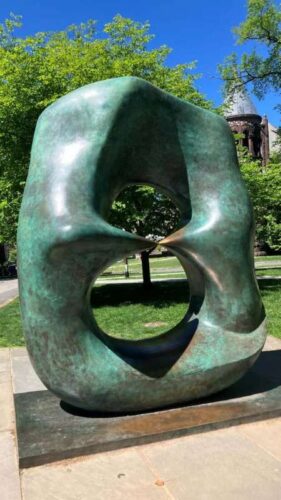
I began at “Oval with Points” by Sir Henry Moore, located near Nassau Hall. This sculpture has been a favorite subject for many photographers since its installation in 1971. Its inspiration was an elephant skull given to Moore by a friend. Moving on to another rounded form…
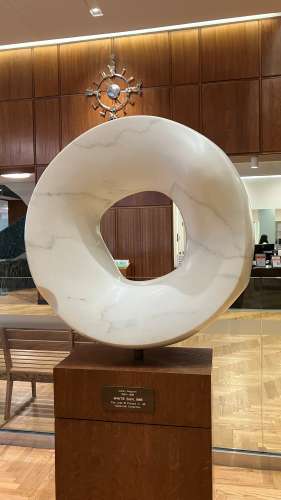
…this is “White Sun” by Isamu Noguchi, sculpted in 1966. This sculpture is located in the lobby of Firestone Library and is the only work listed in the book that is housed indoors. The disc, sculpted from Vermont white marble, is one of many that Noguchi made representing the sun. Other examples are held by museums from Washington, D.C. to Seattle. But, according to the guide, Noguchi said that the one held by Princeton is among his favorites.
…………
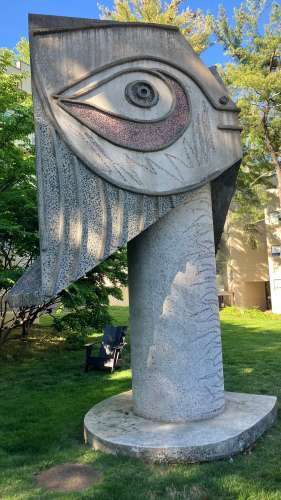
Venturing west and down University Place, I found Picasso’s “Head of a Woman.” It’s a bit hidden on a lawn just south of Spellman Hall. This 16-foot-tall work was designed by Picasso, but was constructed on campus by Norwegian artist Carl Nesjar. It is definitely worth the walk down the hill or as a side trip if you happen to be at McCarter Theatre.
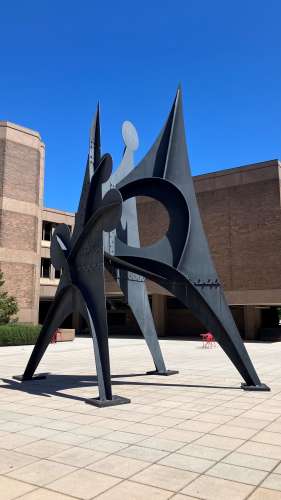
I cut across campus to the east to check out Alexander Calder’s “Five Disks: One Empty.” This massive work stands in the middle of a large plaza next to the towering Fine Hall. This 26-foot-tall sculpture was specifically commissioned for Princeton University by a friend of Calder’s. Apparently, the discs had originally been painted Princeton orange, but Calder was not thrilled with this and had them blacked out when he visited the newly installed work.
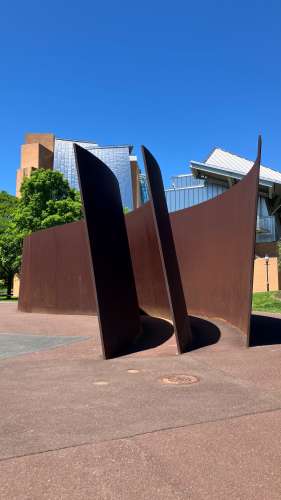
Just to the north of “Five Disks: One Empty” is this monumental work by Richard Serra: “The Hedgehog and the Fox.” Composed of long bands of surface-rusted steel, this sculpture is meant to be experienced rather than just observed. As you walk between the curved, giant arcs, you feel enveloped and maybe even a bit disoriented. Light and shadow interplay, the sky appears and disappears, and sounds echo around you. This is my personal favorite sculpture on campus, but I invite you to find your own the next time you visit Princeton.
All photos by the author.