
Exhibit Info
This Exhibition Is No Longer Showing
Title:
Shaped by Earth, Moved by Water
Dates:
Feb. 15 - Apr. 23, 2026
Location:
Reading Room
About:
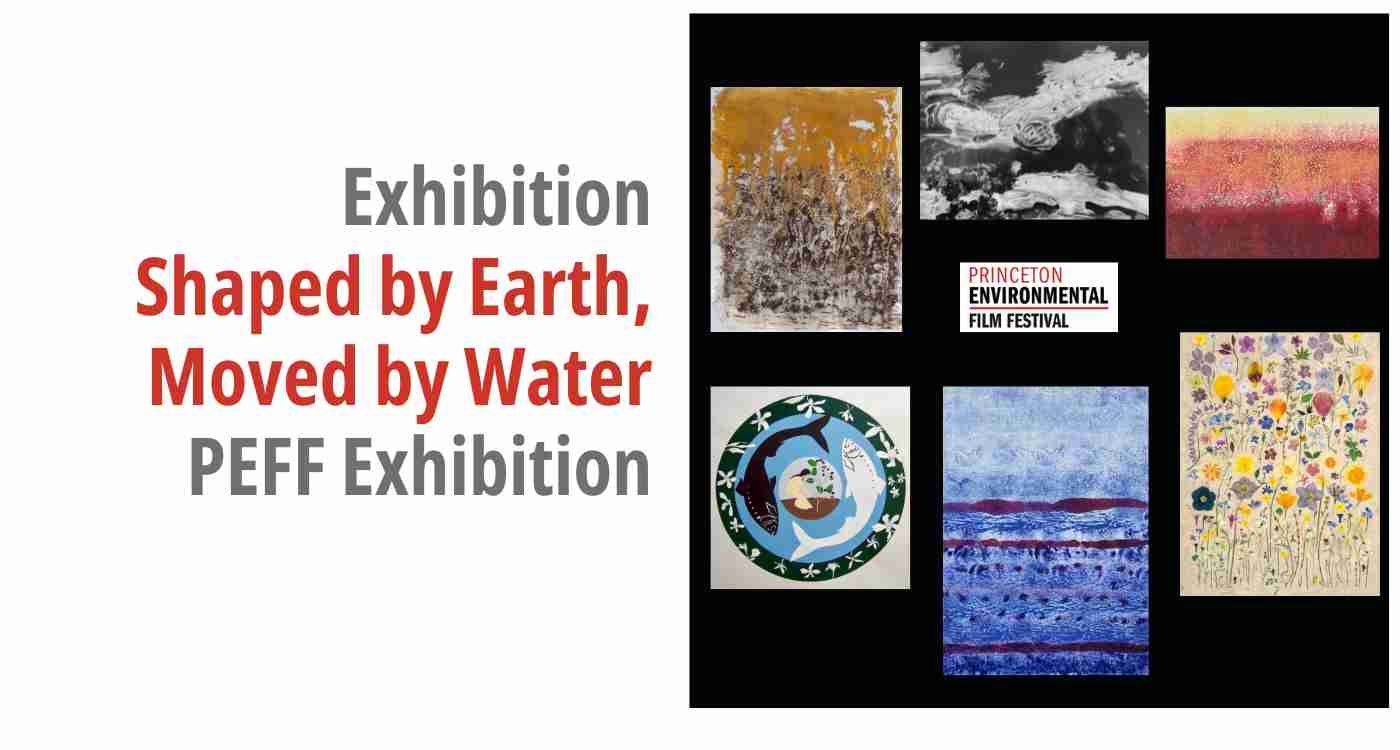
Presented in conjunction with the Princeton Environmental Film Festival “Shaped by Earth, Moved by Water” brings together the work of five Princeton-area artists: Liz Cutler, Clem Fiori, Susan Hoenig, Karen Tuveson and Mary Waltham.
The artists’ works reflect a wide range of approaches from photography and painting, to pressed botanicals and sustainably created media, while engaging deeply with the natural world through its subjects and themes. Their works, whether they are cinematic landscapes or intimate studies of plant life, invite close observation and reflection on environmental change, sustainability, and the interconnected systems that shape both land and water.
Founded in 2007, the Princeton Environmental Film Festival is dedicated to sharing exceptional documentary films and engaging the community in exploring environmental sustainability from a wide range of perspectives. This year’s festival occurring from March 27–April 3 fosters dialogue around our relationship with the environment, exploring the interconnected systems that sustain life and the ways human choices can be both destructive and life-giving. This exhibition extends the mission of the festival beyond the screen, offering another lens through which to consider the environmental questions and concerns at the heart of the festival.
Artist Statement
Liz Cutler: I have always loved nature and it has been the central theme in my personal and professional life. My friends will tell you that I am the slowest walker in the woods because I want to look at everything. My appreciation of nature led me to be a wilderness instructor, a Princeton Day School English teacher with an environmental focus, the founding director of the PDS sustainability program, and now a sustainability consultant with schools all over the country. My art is the creative manifestation of the professional work I’ve been doing my entire life: helping people fall in love with nature. We humans only save what we love.
I began making art for the first time during the pandemic when my 26-year-old son was dying of cancer. These pieces were my meditations then and are my delight now. I hope you love this artwork as much as I love making it, and that it brings you peace and joy. And perhaps, it will help you see nature a little differently too.
Website: www.lizcutlerpressedflowers.com
Clem Fiori is a freelance photographer, artist, writer, and environmentalist whose work bridges art and conservation. He served for many years as principal photographer for the Princeton University Art Museum, the former Woodrow Wilson School, the Publications Office, and other university departments, while also documenting artwork for numerous prominent regional artists.
Fiori’s artistic practice has long explored the natural landscape of New Jersey’s Piedmont region. His book The Vanishing New Jersey Landscape (Rutgers University Press, 1994), supported by a grant from the Geraldine R. Dodge Foundation, reflects this enduring focus. While his early photography employed traditional large-format cameras and silver gelatin darkroom printing, his recent work moves toward abstraction, isolating details, forms, and patterns that echo the textures and movement of the earth’s surface. Today, he blends scanned large-format negatives with digitally generated imagery, producing high-resolution inkjet prints.
His creative work parallels a deep commitment to land conservation. Fiori has chaired the Montgomery Township Open Space Committee since its founding in 1989, serves as a trustee of the New Jersey Conservation Foundation, and advises the Montgomery Friends of Open Space. His photographs have been exhibited widely throughout New Jersey and beyond since 1972.
Website: www.fioriworks.com
Susan Hoenig: Human ecology, the relationship between humans and their environment that sustains them address the importance of biodiversity and conservation. How do the changes in the understory of the forest affect the life of human beings? If the land could speak, what would it say? After many years of exploration in the Abbott Marshlands, my paintings captured the marsh and the ties with a past of Indigenous people 13,000 years ago. Those people are known as the Lenape. I portray parts of the marsh landscape with the goal of leaving the viewer with an understanding of the value of these wild places and the importance of all organisms- plants, animals, fungi, and other less obvious components of the ecosystems. I capture the essence of these people, the unique pottery, and other signs of their presence. During mast years, I collect Black Walnuts from the forest floor to make Black Walnut ink. I dip acorn caps, nuts and seeds in the ink to print their unique form.
Website: www.susanhoenig.com
Mary Waltham: I can never remember a time in my life when I did not prefer to be outside rather than inside. I grew up on a farm, in a small village in Dorset, England. The open spaces outdoors in all seasons were my habitat – – woods, fields, streams, and ponds. In the past there was much greater human involvement and familiarity with the natural world. I was fortunate to gain that experience when young. In later life it enlarges my sense of the world and gives me simple joy.
Returning now to an early passion for art, my work reflects a powerful interest in and curiosity about expressing the fragility of our environment through the eyes of both scientist and artist. My studio is the outdoors. My art is thematic, in series that cluster around environmental themes. For guidance, I am in regular contact with professional scientists. This interdisciplinary approach provides essential factual insight while connecting art to current research-based understanding. I work in a variety of 2D and 3D media, and a range of formats including drawing, painting, video and installation works. My work often incorporates landscape materials collected locally such as soil, bark, moss, and wood. I want to bring the landscape to life, and so to spark fresh conversations and awareness of current urgent environmental issues
My work is exhibited regularly in juried shows in the US and the UK and is in public and private collections.
Website: www.MaryWaltham.com
Karen Tuveson is a New Jersey–based sustainable artist whose work explores the layered relationships between land, memory, and environmental stewardship. Working across oil painting, mixed media, and papier-mâché, she incorporates natural elements such as sand, botanicals, and clay into pigments and cold wax to create textured surfaces that reflect both the visible and unseen patterns of the natural world. Her practice is deeply influenced by a rural Midwestern upbringing and a continued commitment to honoring local landscapes through material and process.
In addition to her studio work, Tuveson is a community-based arts leader and founder of Catalytic Arts, a nonprofit dedicated to expanding access to meaningful creative experiences. She has developed and led numerous public art and community initiatives throughout Central New Jersey, including collaborative exhibitions and rural public art projects that celebrate regional heritage and environmental awareness. Her work invites viewers to slow down, look closely, and reconnect with the quiet complexity of the natural environment.
Website: www.karentuveson.com
Website
Social Media
Instagram: @lizcutlerpressedflowers
Instagram: @shoenig84
Instagram: @waltham2024
Instagram: @karen.tuveson