
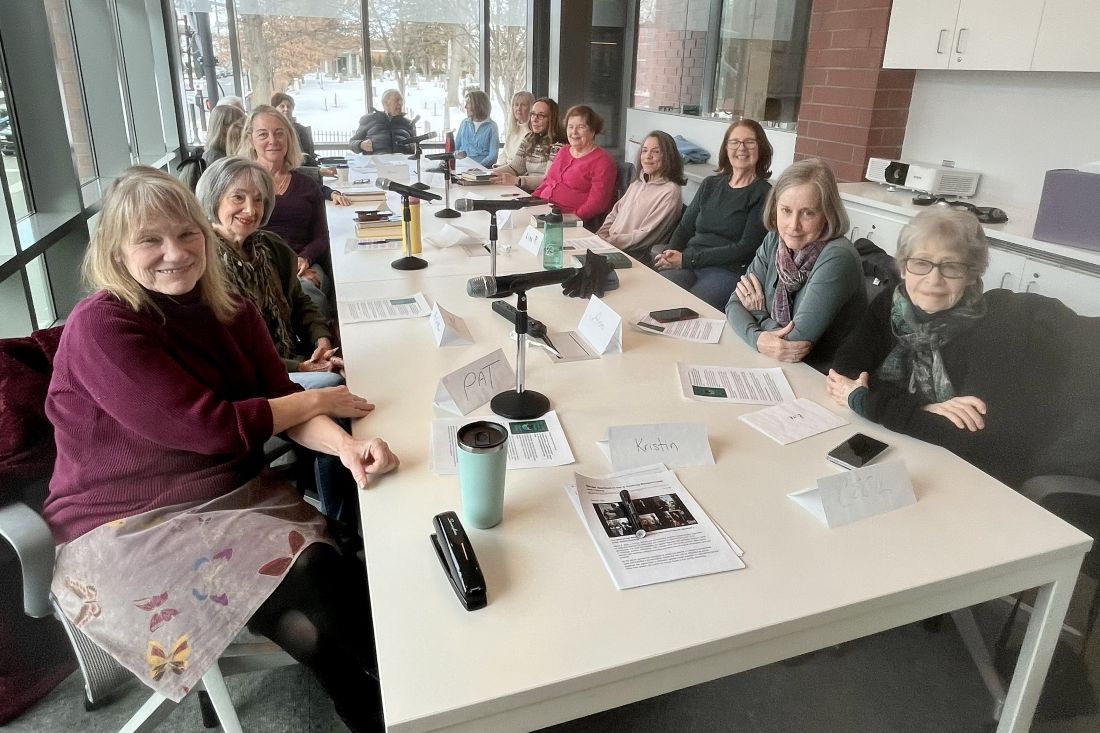
A familiar misconception of reading fiction versus nonfiction is that one must reach for nonfiction books if they wish to learn about something authentic, and that reading a work of fiction is a waste of time. However, as the facilitator of the library’s longstanding Fiction Book Group, I’d like to challenge this notion. While I enjoy reading both nonfiction and fiction, in my years of experience, I have learned that the latter can serve as a gateway to knowledge and empathy that cannot always be found through reading nonfiction, alone. Those who attend the Fiction Book Group always have a lot of thoughts about what they’ve read, and they are the first to say that they often leave each meeting with different feelings and perspectives than when they arrived. Perhaps taking account of the group’s recent selections might have you reconsidering your own views on fiction, as well.
“The Lion Women of Tehran” by Marjan Kamali, which was February’s read, begins in 1950s Iran and spans decades, telling the story of a lifelong friendship between Ellie and Homa. Their lives intertwine when Ellie’s dad dies, forcing her and her proud mother to relocate to an area they can afford. Issues of class permeate the story as Ellie realizes that close family relationships are more valuable than material wealth, though her mom feels otherwise. Spirited Homa, a vibrant social activist from a young age, is a delightful counterpoint to reserved Ellie, who grapples with behaving in the manner her mom models. Disguised as a compelling story of the bonds between two women, of tremendous value is its invitation to readers who know nothing about Tehran’s history to learn more about living as a female under an oppressive political regime.
One summer night, 10-year-old Louisa goes for a walk with her dad along the water’s edge. Her overly cautious father (who cannot swim) carries a flashlight with them, but something awful happens, and he is presumably lost to the sea. Louisa’s recollection and trauma from the event is the subject of the short story, “Flashlight” by Susan Choi. The library’s Fiction Book Group discussed the piece last summer and then met earlier this month to talk about Choi’s follow-up novel of the same title that traces the repercussions of this family’s tragedy over the course of decades. Choi does an exquisite job of telling vital pieces of the history of North and South Korea, and the relationship with Japan and the United States. Each character is rendered authentically, not necessarily likeable, but as understandable people. The joy of reading fiction written by a skilled writer is being able to identify with its characters, recognizing relatable traits and reactions. It’s the universality of being human, with all of its faults, that when written well, can contribute to becoming more empathetic in one’s real life.
During both of these discussions, several book group participants confessed to being ignorant of the history of the countries represented in the novels. What is valuable is the recognition of a lack of awareness that opens the door to further investigation. Reading historical fiction often triggers curiosity and further research. There have been countless times that people have said that reading novels caused them to dig into history to find out more about the actual events and timeline of the subjects. During the discussion of “Flashlight,” these feelings were explicitly voiced by several members, so much so that I took notes so that I could quote them. “When we read fiction, we walk away with a greater sense of empathy.” “Fiction is vicarious learning. That’s how we learn.” “Fiction really takes you to another place, so you can feel what it’s like to be in someone else’s position.”
Whatever books you choose to read, know that we are just happy that you are reading. And, whether you are interested in fiction or nonfiction, if you are ever in need of a recommendation (or a few), try our PPL BookMatch service. See you at the library!
Photo of the library’s Fiction Book Group, taken by the author.