
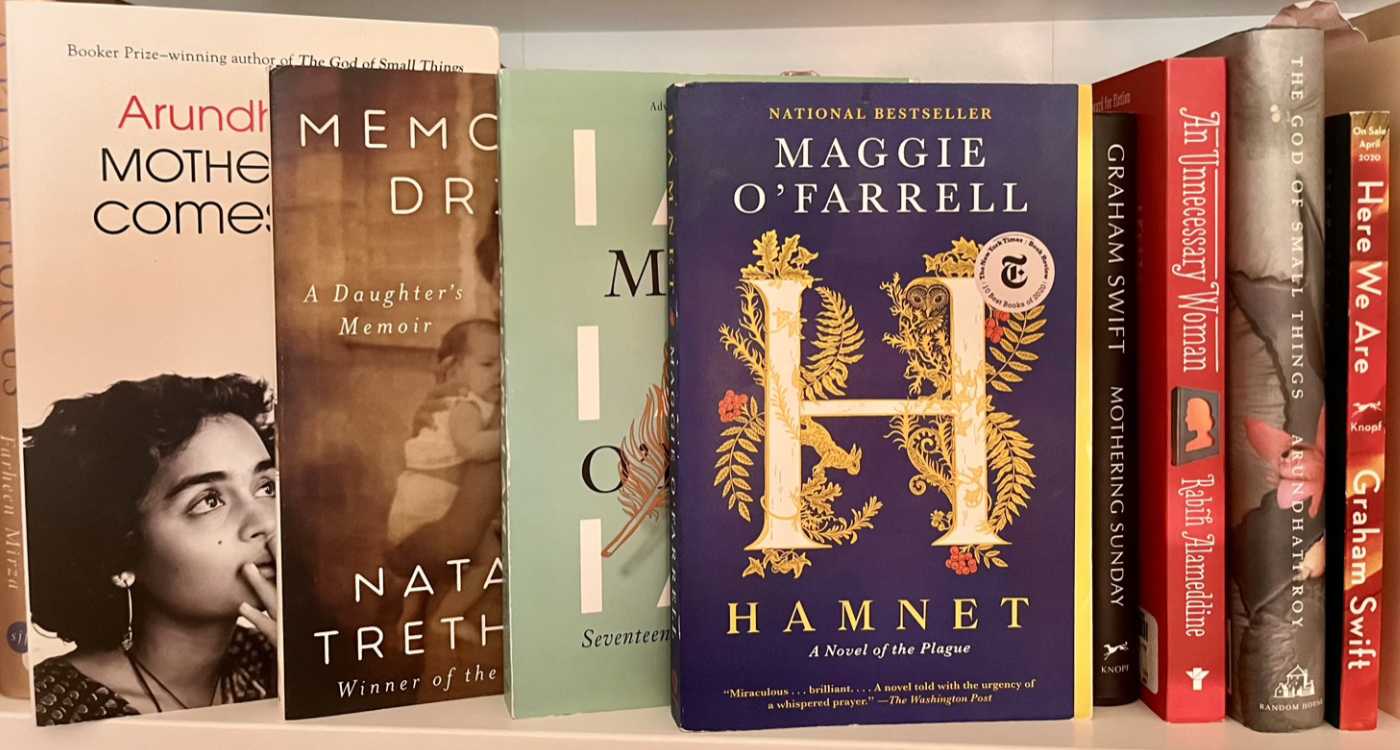
No matter how old we are, our identity remains inextricably linked to those who raised us. As another Mother’s Day approaches, it’s a fitting time to reflect on our relationships through literature’s lens. There are so many ways one can be a mother. Here are several contemporary takes on the pivotal role. Perhaps you can relate.
When author Jedidiah Jenkins’ mother, Barbara, turns 70, he begins to realize that she will not live forever. While they shared a love of true crime, thrifting and eating at diners, they disagreed about some major issues, including politics and religion. In “Mother, Nature! a 5,000-mile Journey to Discover If a Mother and Son Can Survive Their Differences,” they embark on a journey, retracing the thousands of miles Barbara trekked with Jedidiah’s father, travel writer Peter Jenkins, as part of the Walk Across America book trilogy. Beginning in New Orleans, they set off for the Oregon coast, listening to podcasts about outlaws and cult leaders—the only media they can agree on—while reliving the journey that changed Barbara’s life.
“The Wanderer’s Curse” by Jennifer Choi
In 2022, Jennifer Hope Choi stumbled upon the concept of yeokmasal—a supposedly inheritable affliction that causes one to roam far from home. Over the course of 15 years, her own mom had moved to seven states, from California to places as far-ranging as Alaska and Florida. Once Choi’s own life implodes, she finds herself shuttling from Brooklyn to South Carolina and Oklahoma. As these singular women drift apart and return to each other over time, Choi examines where and to whom she belongs.
“Mother Mary Comes to Me” by Arundhati Roy
“Heart-smashed” by her mother Mary’s death in September, 2022, yet puzzled and “more than a little ashamed” by the intensity of her response, author Booker Prize-winning Arundhati Roy began to write. She wanted to make sense of her feelings about the mother she ran from at age 18, “not because I didn’t love her, but in order to be able to continue to love her.” And so begins this astonishing, sometimes disturbing, and surprisingly funny memoir of the author’s journey from her childhood in Kerala, India, where her single mother founded a school, to the writing of her prizewinning novels and essays, through today.
“Memorial Drive” by Natasha Trethewey
I was unsure whether I wanted to read Pulitzer Prize-winning poet Natasha Trethewey’s “Memorial Drive” due to its devastating exploration of trauma , but I could not put it down after reading the first few sentences. In this “beautifully composed, achingly sad memoir, U.S. poet laureate Trethewey (Monument) addresses the 1985 murder of her mother, Gwendolyn, at age 40, at the hands of her ex-husband, the author’s former stepfather. Over the course of the narrative, Trethewey, 19 at the time of the killing, confronts her wrenching past, which she avoided for decades, as she tries to undo the “willed amnesia buried deep in me like a root.” (Publishers Weekly)
“The True Story of Raja the Gullible (and His Mother)” by Rabih Alameddine
I recall being blown away by Rabih Alameddine’s writing of “An Unnecessary Woman.” The protagonist of that novel is an elderly woman, deeply introverted, divorced and childless. “The True Story of Raja the Gullible (and His Mother)” was the recipient of the National Book Award for Fiction in 2025. If you are unfamiliar with Alameddine, I encourage you to check out his writing.
In a tiny Beirut apartment, 63-year-old Raja and his mother live side by side. A beloved high school philosophy teacher and “the neighborhood homosexual,” Raja relishes books, meditative walks, order, and solitude. Zalfa, his octogenarian mother, views her son’s desire for privacy as a personal affront. She demands to know every detail of Raja’s work life and love life, boundaries be damned. When Raja receives an invite to an all-expenses-paid writing residency in America, the timing couldn’t be better. It arrives on the heels of a series of personal and national disasters that have left Raja itching for peace and quiet away from his mother and the heartache of Lebanon. But what at first seems a stroke of good fortune soon leads Raja to recount and relive the very disasters and past betrayals he wishes to forget. Told in Raja’s irresistible and wickedly funny voice, the novel dances across six decades to tell the unforgettable story of a singular life and its absurdities-a tale of mistakes, self-discovery, trauma, and maybe even forgiveness.
In a note from the inestimable editor Jordan Pavlin on Maggie O’Farrell’s memoir, “I Am, I Am, I Am,” he writes, “This book, like its title, which is a line from Sylvia Plath’s “The Bell Jar,” is a cry of tenacity and love in the face of darkness and death. Maggie wrote it to help her daughter–who lives with a life-threatening immunological disorder–understand that she is not alone.” O’Farrell chronicles 16 of her own brushes with death, and ends with one of her daughter’s experiences.
O’Farrell revisits motherhood in “Hamnet.” This exquisite novel explores the strength, love and passion of Agnes, the fictionalized version of William Shakespeare’s wife and mother of his children, as she wrestles with the grief of losing her beloved son, Hamnet.