
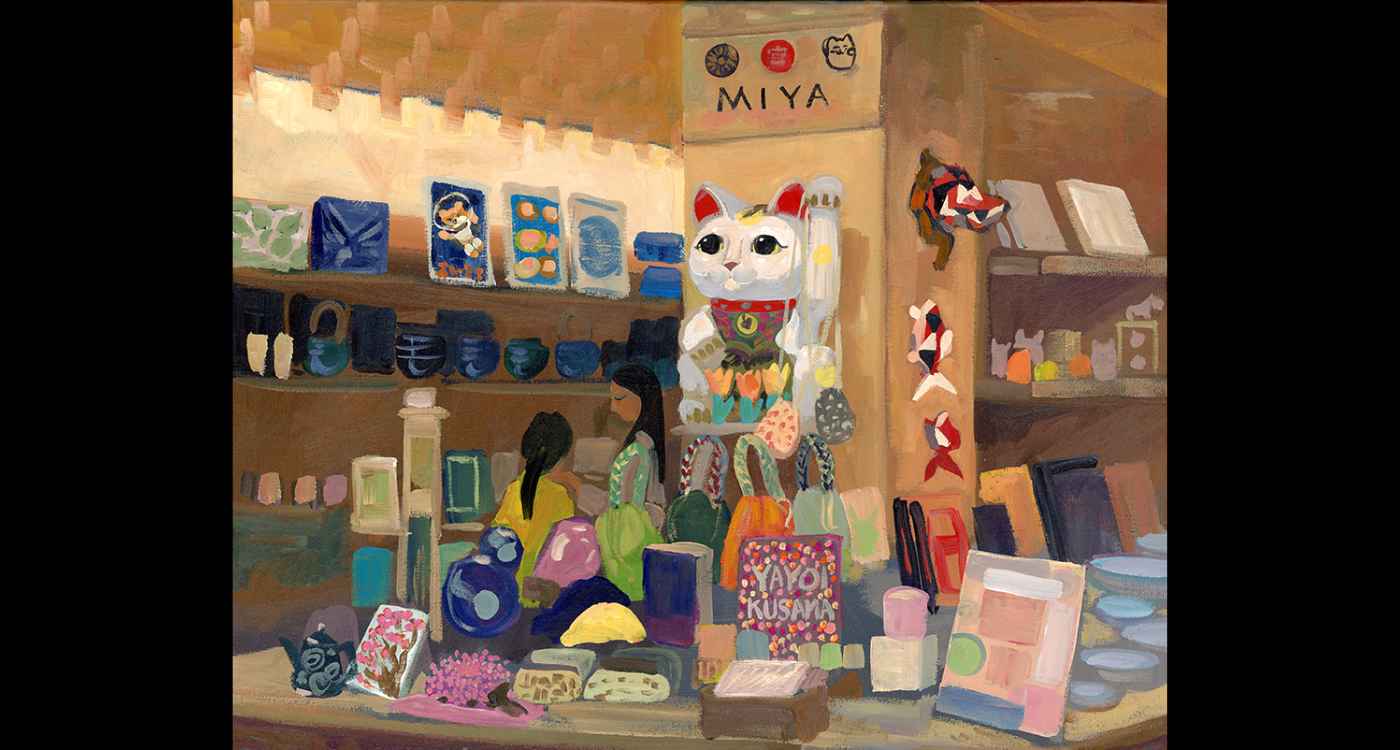
The history hallway and tech center on the second floor of the library currently features “The Places We Shop – Princeton Series,” an exhibition of paintings by artist-in-residence Barbara DiLorenzo. The artist graciously agreed to be interviewed so that readers may learn more about her experience creating the series of paintings and the significance of the project for the community.
Q. One of the delights of viewing “The Places We Shop – Princeton Series” for me has been the way in which it invited me to reflect upon my relationship to our local businesses. In one way, the relationship with a business is transactional — we go in to make a purchase and take away a consumable or a good. But in a deeper way, businesses are real anchors of place and community, so that the staff with whom we interact, the owners who steward the operation’s success, and our frequent encounters contribute to a shared sense of belonging. Considering the entire series, now that you have observed these places in such a careful way, as you were completing this first pass, what have you found distinctive about the contribution of these businesses to the community?
A. When I began this experiment in Massachusetts almost two decades ago, I aimed to make an impartial comparison between large chain stores and small, independent retailers. In my heart, I had my preference for which retail space I preferred, but it was amazing how the paintings told the story for me. For example, a painting of BJ’s Wholesale Club from the parking lot ( I wasn’t allowed inside) was hung alongside a much more intimate and lush depiction of Green Meadows Farm Stand. It was easy to love the small businesses because every single one let me in, gave me snacks, and celebrated the project.
Almost two decades later, in New Jersey, I decided to rekindle this project for the Princeton Public Library. While some things had changed, like my endurance to paint for four hours straight, some things had not. Small businesses in another decade, in another state, were just as lovely, accommodating, and wonderful to work with. And with the extra time I’ve spent in this community, I know how some of these folks have helped others.
One example of this is LiLLiPiES. My introduction was not by eating their delicious treats but through the art of one of my students, Sofia Schreiber. She worked at LiLLiPiES and created illustrations of baked goods for the owner, Jen Carson. Sofia reached out for advice after Jen invited her to collaborate on a picture book. I saw their beautiful book come to life before Sofia went to art school- sending her to college already a published illustrator.
What I didn’t know is that LiLLiPiES is still nurturing other talent as well. I painted Jeff Trainor at the register, noticing the time he took to connect with the youngest customers. I then learned he is Jeff from “Storytime with Jeff” and often performs at LiLLiPiES.
While it may appear that I’m against big, chain stores and the people who work there, I am not, for two reasons. The first is that regular people work in these spaces, including plenty of creative people. While red tape and company policy might stifle the individual’s ability to make creative decisions at work, the staff in chain stores deserve the same respect.
The second reason I’m not against chain stores is that their market force is important. Umesh Bhuju, the owner of Zumis in Ipswich, MA, pointed this out to me. His shop carries only organic and fair-trade coffee, but this makes only a small dent in that market. When a giant coffee chain (rhymes with Barbucks) carries organic, fair-trade coffee options, the supply chain shifts.
That said, Zumis in Ipswich, MA, and Small World Coffee in Princeton, NJ, are full of local art, local musicians, and local people talking to each other. No corporate branding can replace an authentic, homegrown community.
Q. Each of the paintings featured in “The Places We Shop – Princeton Series” comes together as acrylic on canvas, painted both “alla prima” and “en plein air,” as you explain in your statement on this series. The result is a painting with a strong sense of framing and a clear point of view, so that one can really see the store from your perspective. How did you settle on this technique for this series? Is it a legacy of your work in Massachusetts? What advantages or disadvantages does proceeding in this way involve?
A. I have always enjoyed painting en plein air, but painting inside a shop feels different than drafting a landscape. To handle the pressure of painting, talking, and having people look at the work, I let go of my expectations. I trust the process of my eye and hand working together, and soak up my surroundings.
Sometimes customers really want to talk. I put my brushes in the water so they don’t harden with dried paint, and focus on the person. After all, the entire point of this painting project is to engage with the store and its people. They often tell me about their creative journey – it has nothing to do with me. As an art teacher, I absolutely love and encourage this.
Usually, at the 4+ hour mark, I stop because my joints ache. When I get home and want to touch up the work, I remind myself that the entire point is to capture the feeling of being there, not make a photorealistic reproduction. Sometimes, time away from our creations gives us greater clarity, so after a few weeks, I accept where the work has landed.
Q. Each of the short narratives featured alongside the paintings equips them with a certain anecdotal accompaniment, as if you’ve brought out something of what you can see there in the medium of the written word. Similarly, they have a strong first-person point of view. In reading them, I wondered how much you were deliberately bringing out this similarity of perspective. How do you imagine these short narratives stand in relation to the paintings, which after all, can speak for themselves?
A. Because I love words and illustrations, the journal entries were a natural accompaniment for this series. That may be because when working on my own picture books, I love the challenge of deciding when to use words and when to let imagery carry the scene. When the combination is right, the emotion hits you on a few different levels.
My perspective on this project is only one view. It would be fun to see how other painters depict these spaces and experience the places we shop.
Photo Credit: courtesy of Barbara DiLorenzo.