
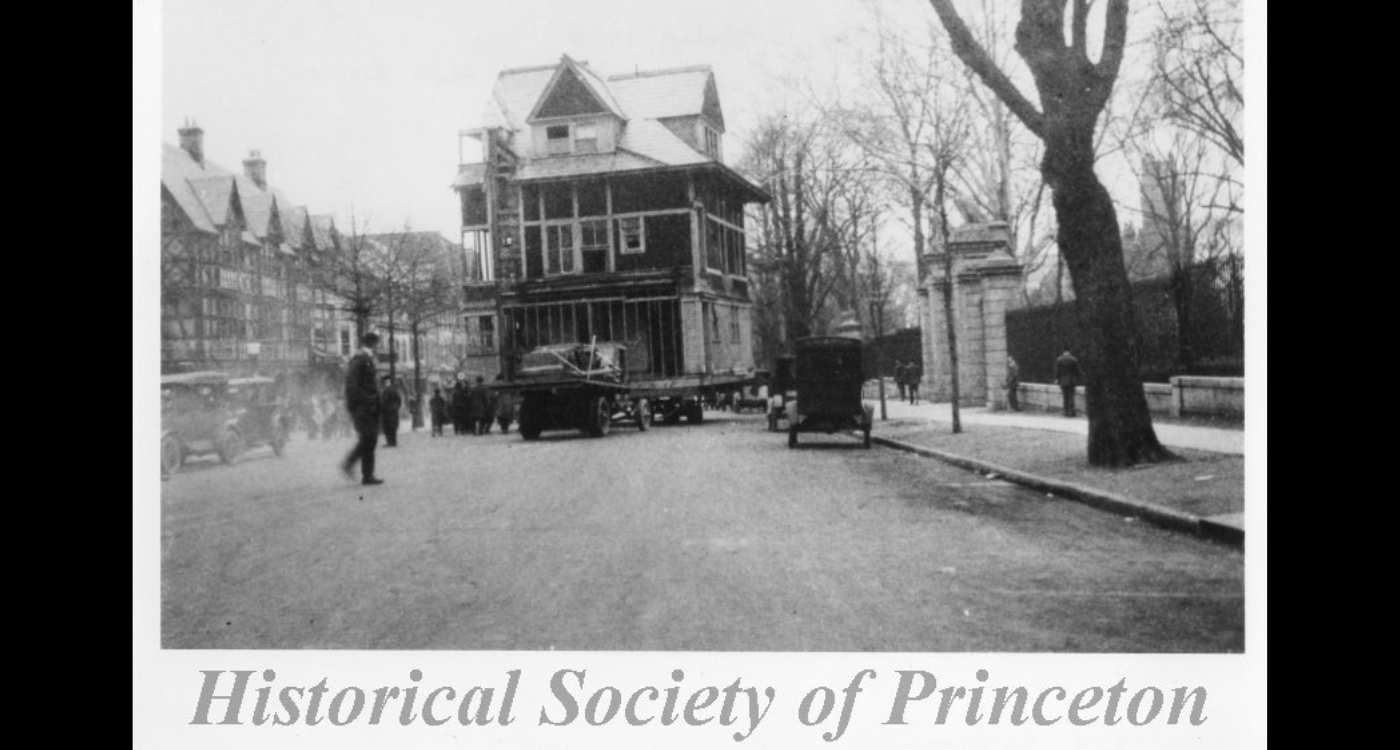
I have never seen a community more proud of its history than Princeton. Visitors, residents and researchers come to the library to discover something new about Princeton history—some to research their family’s roots, others to inquire about former businesses on Nassau Street. It’s clear that, from evolving waterways and roads to new businesses and, most recently, the Princeton University Art Museum, the landscape of Princeton is always changing.
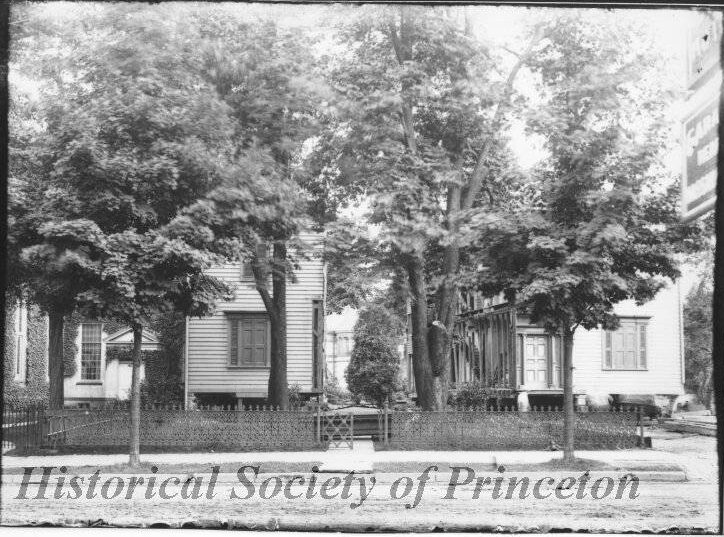
One topic of conversation that is always fun to discuss is Princeton’s “moved houses.” As the town and Princeton University in particular grew, houses and businesses were often in the way of expansion. While many were simply torn down, many historic homes and buildings in Princeton were moved to other locations. Houses were lifted manually and placed on wheeled platforms. Very slowly, these structures were then pulled to their new locations.
The Beatty House:
Originally located on Nassau Street, Beatty House was the home of the Hudibras Tavern proprietor, Jacob Hyer, who is thought to have built the house in 1780. In 1816 the house was purchased by Colonel Erkuries Beatty. After Beatty’s death in 1823, the building housed Miss Hanna’s Boarding School for young women. James Vandeventer, merchant and longtime Princeton resident, purchased the house and moved it to its present location on Vandventer Ave. in 1875.
The Bartine House:
Originally owned by Dr. Bartine, the west wing of the house had already been removed prior to its relocation when Vandeventer Avenue was widened. The house was then moved next to the Beatty House on Vandeventer Avenue in 1910 due to the expansion of the Princeton United Methodist Church.
The Howell/Alexander/Cornwall House:
Originally located on Nassau Street next to the First Presbyterian Church, the home, also called the Stephen Alexander House, was cut in two and moved to 12 Morven Place in 1905.
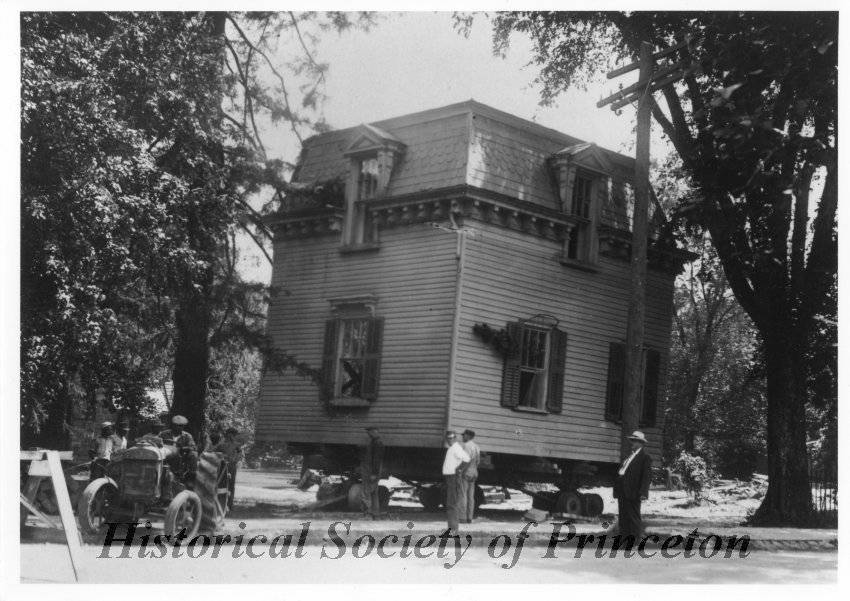
The Peacock Inn:
Built in 1779 on Nassau Street near what is now University Place, this building was purchased by Continental Congress member Jonathan Deare. In 1875, the building was relocated to its current location at 20 Bayard Lane and converted to a hotel.
Birch Avenue:
To make way for Palmer Square, dozens of homes were moved from Baker’s Alley and nearby streets to Birch and Leigh Avenues. This meant the relocation of the majority of Princeton’s African American community. Today, these homes are part of the Witherspoon-Jackson Historic District, which is bounded by Jackson Street and Birch Avenue on one axis and Witherspoon and John Streets on the other. For more information about this historic community, consider exploring the Heritage Tour, part of the Witherspoon-Jackson Historical and Cultural Society.
342 Nassau Street:
According to the Historical Society of Princeton, this home is one of the earliest in the Jugtown district still standing, dating from 1730. To me, the most interesting part of this home is its clapboard wing. Originally located on the left side of the building, it was moved to the right to allow for widening of Harrison Street.
The history of Princeton’s “moved houses” is just one example of the town’s fascinating evolution. Visit our Princeton and Local History: A Resource Guide and our Princeton History research site to dive deeper into Princeton’s past.
Resources: The Historical Society of Princeton, The Witherspoon-Jackson Historical and Cultural Society, The Peacock Inn, and The Princeton History Journal.
All images are courtesy of The Historical Society of Princeton.