
Most people working in public programming and in cultural institutions have been planning for a long time for the coming U.S. Semiquincentennial celebration, the 250th anniversary of the founders’ signing of the Declaration of Independence. That anniversary is understood generally as the 250th anniversary of the United States of America and thus offers an opportunity to reflect upon our national history, the place of the country in the world today, and what the future holds for us.
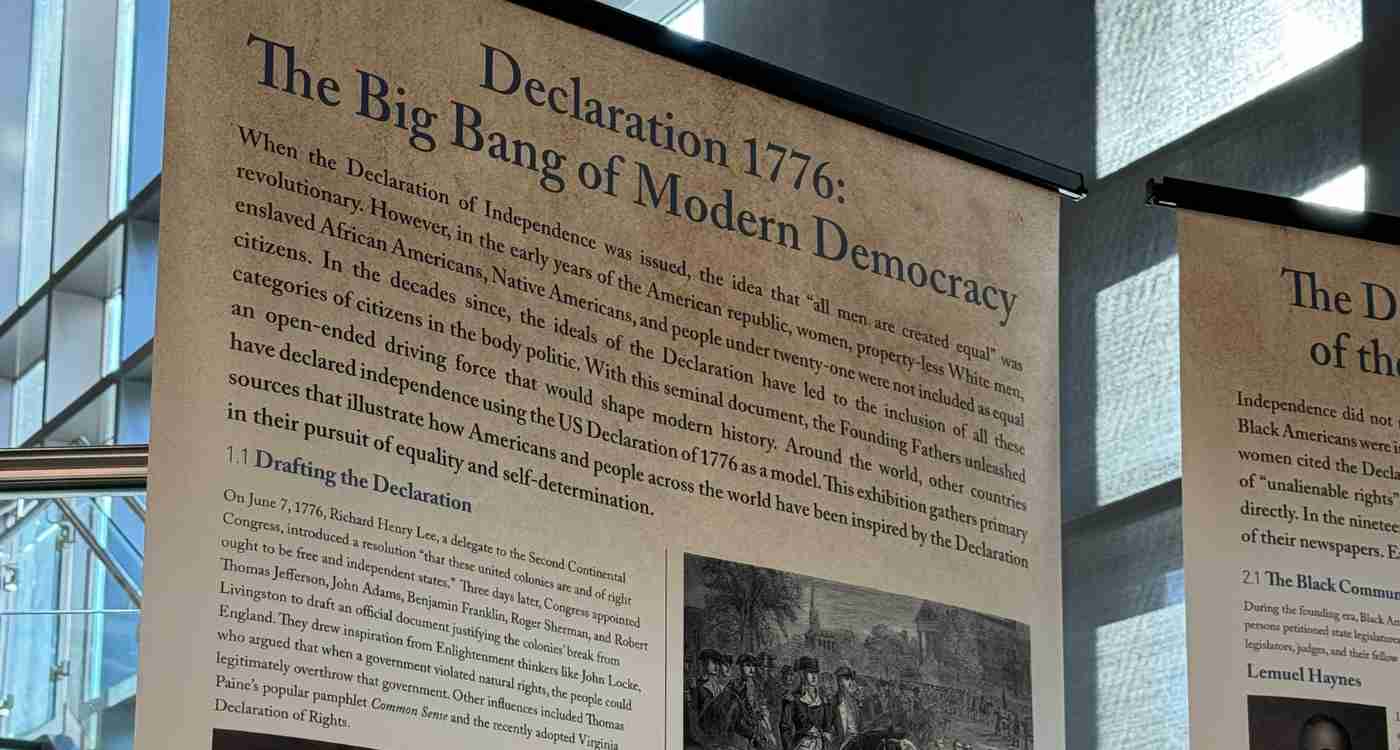
The celebration itself will unfold through the calendar year, and in many ways it has already begun, with the parade celebrating the U.S. Army’s 250th anniversary this past summer and the PBS series “The American Revolution.” The library has also begun exploring the meaning of this national commemoration. Last week, through support from the library’s public humanities initiative, an exhibit on loan from the Gilder Lehrman Institute came to our Lobby, and it will be on display through the end of January. “Declaration 1776: The Big Bang of Modern Democracy” interprets the U.S. Declaration of Independence as “an open-ended driving force that would shape modern history,” tracing the impact of the document on revolutionary movements across the globe and down to the present day. It invites us to consider not only how interpretation of the Declaration opened up possibilities for historically oppressed or marginalized groups throughout American history; it also traces its contribution to movements for liberation in Haiti, Venezuela, India and Ukraine, among other places.
This exhibition is just the first of many planned programs and projects which the library’s public humanities initiative will deploy in 2026, in order to contribute to the public conversation on the U.S. Semiquincentennial celebration. A certain hazard is involved, though, in devoting so much time and energy to commemorating the legacy of a document as consequential as the Declaration. If we do not consider the broader context for the American Revolution and isolate it as a singular achievement in modern history, the solemn reflection on this anniversary’s meaning may unwittingly contribute to narratives of American exceptionalism, which have proven both risky and harmful in foreign and domestic affairs alike. By exploring the topic of revolution more broadly, there will be opportunities to investigate the history of the American Revolution and its consequences for our national history, even as that history is situated with respect to a more far-reaching history of revolutions in the modern period. Virtual and in-person author events, book discussions, special events and oral history projects are already in the works, and more possibilities are sure to arise over the coming months.